Version FrançaiseWith Radiance’s limited-edition Blu-ray release of Ten Women in Black, I wanted to take a closer look at the film and share with you why, in my eyes, it deserves to be discovered — or rediscovered
For me, its title alone, straight out of some wild concept, and its strikingly solemn poster were enough to make me buy the Blu-ray without hesitation. Since watching it, the film has stayed with me for many reasons, which I thought I would explore through a list of ten that might, in turn, make you want to discover it.

A cast of stars to make any credit sequence blush.
Alongside Keiko Kishi, the film brings together Fujiko Yamamoto, Kyōko Kishida, Mariko Miyagi and Tamao Nakamura, among others: a constellation of Japanese cinema stars from the 1960s. The cast alone is quite an achievement.
Keiko Kishi’s magnetic presence.
She sadly passed away only very recently, and it would be difficult to do justice to her immense career here. Let us simply say that, impressive as the cast is, she still manages to steal several scenes from the other actresses through sheer presence and modernity. She brings authority, subtlety and ambiguity to the ensemble. Often set in direct opposition to Fujiko Yamamoto’s character—another great actress who deserves our full attention—her character and Yamamoto’s create two portraits of modern Japanese women who command the viewer’s attention. In the scene where they talk while never stopping their guarded glances, they are different, barely like one another, yet understand each other. Keiko Kishi lights a cigarette in front of Fujiko Yamamoto with a provocative smile. Chills.

Black-and-white cinematography of razor-sharp beauty.
Setsuo Kobayashi’s photography turns offices, apartments, bars and streets into graphic, almost abstract spaces. Its deep blacks lend the film a poisonous elegance. The actresses and actors are magnificently photographed, as in the wonderful opening credits, which introduce the principal characters as they emerge from darkness and are born, one by one, into the light. One of the most beautiful black-and-white films of its era—and far beyond it.
Kon Ichikawa films comedy like a thriller.
Threats, surveillance, secret meetings, anxious framing: the direction readily borrows from film noir, even as the film remains a fierce satire. This blend of genres reveals both Kon Ichikawa’s intelligence and his versatility.

Kon Ichikawa
A genuinely funny—and cruel—black comedy.
This is not merely a marital drama: the film takes its absurd premise all the way into black comedy, without ever absolving its hero. He is sometimes made ridiculous, but the women are not entirely spared by the satire either.
Natto Wada’s strikingly modern screenplay.
The screenplay, shaped by a woman’s perspective, feels astonishingly modern. Wada refuses to reduce the mistresses to an interchangeable mass, and observes power dynamics with great sharpness. Kon Ichikawa’s wife as well as his screenwriter, Natto Wada was one of those great writers whose career was cut short too soon by illness. Hers was a rare female perspective in an industry then overwhelmingly controlled by men.

Natto Wada
Ten women, ten ways of existing within the same trap.
The film does not simply oppose “women” to “man”: it brings out desires, rivalries, solidarities and contradictions within the group itself. Its portraits are as varied as people are in society, giving the film a subtlety that keeps it from ever becoming simplistic.

A biting portrait of Japan at the dawn of television.
The protagonist works for a television network in full expansion. This setting allows the film to capture an urban, hectic and already highly media-driven modernity. It speaks of Japan in the midst of its modern transformation, rather than through a traditional lens. This makes the film feel even more contemporary, while also showing an environment that was becoming a competitor to cinema at the time: a rare opportunity to see cinema talking about television at the height of its rise.
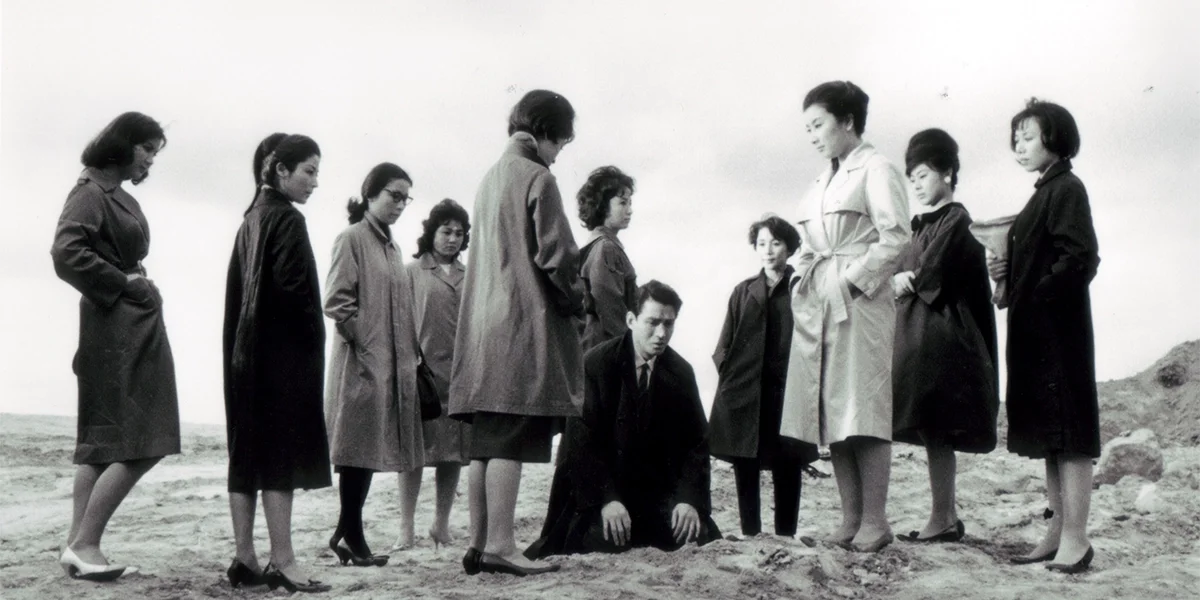
The nightmare sequence: revenge becomes cinema.
The male character’s fantasy finds him pursued and killed by his mistresses, all gathered around him as he falls to his knees. An immensely exhilarating piece of cinema.

An ending that refuses comfort.
Without revealing it, the film’s ending upends what we expect from its resolution and lets the discomfort linger beyond the final shot. Unexpected in its own way, and deeply ironic about what its characters hope for, it offers a smart vision you will not see every day.
I hope this has made you want to discover Ten Women in Black, a film that remained unavailable in our part of the world for far too long and now benefits from a beautiful Radiance edition following its magnificent 4K restoration. The Blu-ray also includes several extras, including a documentary directed by Shunji Iwai. Grab it while it is still available—you will have to let me know what you think.